February 17, 2026
I will begin by saying that I am not and never will be a physicist. Never in my wildest dreams would I have imagined weaving in quantum mechanics into a discussion of Catholic spirituality and Internal Family Systems (IFS)! Nevertheless, mortals go where angels fear to tread. I have been fascinated by many articles written for the average layman in journal magazines such as Popular Mechanics and Quanta Magazine which make some wild claims about the universe, or perhaps I should say, about the multiverse.
As I peruse these articles which summarize this or that study, I cannot help but think that, if the studies have even a glimmer of truth to them, how amazing is our God. My favorite saint, Maximus the Confessor, described the human person as a microcosm of the larger universe and we went into depth on this theme in episode 169 of the Interior Integration for Catholics podcast titled St. Maximus the Confessor and Catholic Parts Work. Quantum mechanics teaches us that there is in fact a universe within each one of us, in fact, a universe inside each and every atom in our bodies.
To be clear, the connections I will make in this article are highly speculative. They are merely my reflections and reactions as I try to make sense of a difficult and complex area of scientific study. And if any physicists are reading this, feel free to reach out and comment and even offer corrections (charitably, please) if warranted. I am not trying to prove anything here. I do not want to force a connection between two fields of study, theology and physics, which each have very different aims and aspirations from the other.
I will, however, offer my initial reactions, some reflection, and then I will pose a few questions. How does quantum theory reflect a Creator? What does quantum theory say about this Creator’s action in the world? Does God act at a quantum level?
What is quantum mechanics?
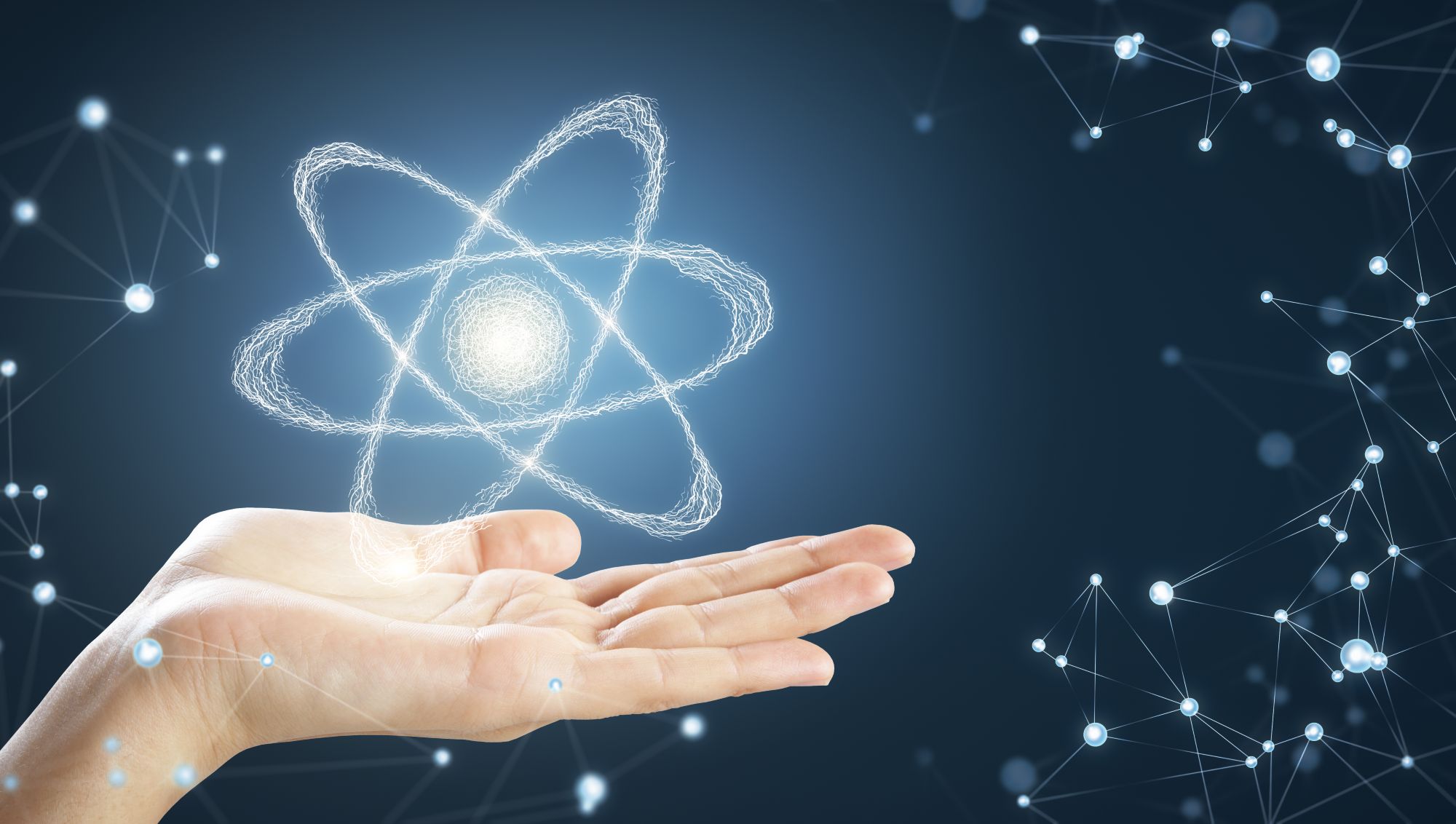
Before I get ahead of myself, let us take a moment and define quantum mechanics for the non-physicists among us (including myself). It is a branch of physics that deals with the behavior of very small particles, such as atoms and subatomic particles, at the smallest scales of energy levels. Unlike classical physics, which describes the behavior of larger objects, quantum mechanics focuses on the unique properties and interactions of these tiny particles.
And in case you need to be baffled, here is a fascinating fact: in one single human cell there are approximately 100 trillion atoms. These atoms consist of elements such as carbon, hydrogen, oxygen, nitrogen, and phosphorus.
A relatively recent discovery is that these tiny particles (e.g. electrons and photons) can behave like particles or behave like waves. When behaving like a particle, the particle has mass, charge and spin and behaves like an individual entity with distinct characteristics. However, when behaving like a wave, the particle can spread out in space creating interference patterns. Here I think of sound waves or magnetic waves which we cannot see and yet they “bump” into things and have an effect. As a wave, a particle does not have a defined position but exists as a “probability distribution” in space.
Superposition
Another mind-blowing notion in quantum mechanics is superposition. This means that a particle can exist in multiple states or locations simultaneously until it is observed or measured. This phenomenon is famously illustrated by Schrödinger’s cat experiment, where a cat in a closed box is considered both alive and dead until the box is opened and the cat’s state is observed.
Suddenly bilocation by Padre Pio and others feels less like science fiction… even in the natural realm, at a subatomic level, God has at His disposal so many options we are simply unaware of.
Entanglement
Furthermore, quantum mechanics involves the idea of entanglement, where particles become interconnected in such a way that the state of one particle instantly affects the state of another, regardless of the distance between them. This phenomenon has been demonstrated through various experiments and has implications for the concept of non-locality.
So, particles can affect each other even though they are very far from each other… Similarly, our prayers can make a difference no matter how far away we are from each other.
Having made that connection, I do believe particles transmit information about emotions and cognitions but I am not sure that can be scientifically proven at this point.
Uncertainty principle
Quantum mechanics also includes the uncertainty principle, formulated by Werner Heisenberg. This principle states that the more precisely we know the position of a particle, the less precisely we can know its momentum, and vice versa. This inherent uncertainty at the quantum level challenges our commonsense intuition but is a fundamental aspect of the behavior of particles at the smallest scales.
Bottom line here, there is so much we do not know about how particles operate at a subatomic level. There is so much that the eye cannot see. We cannot assume that the same laws apply at the quantum level compared to what we experience in the “larger” world.
In summary, quantum mechanics describes the strange and fascinating world of the very small, where particles can exist in multiple states, exhibit wave-particle duality, be entangled over long distances, and “obey” the uncertainty principle. While the concepts of quantum mechanics can be challenging to grasp without a scientific background, they offer profound insights into the nature of reality at the quantum level.
Quantum mechanics and prayer
In my view, many difficult-to-believe Catholic spiritual and mystical experiences do not seem so impossible when viewed with an understanding of quantum mechanics. The first area to explore is prayer.
I feel the need to offer this caveat: the application of quantum mechanics to explain the power of Christian prayer is still a speculative and controversial area of discussion. The interpretation of quantum phenomena in relation to consciousness, intention, and spirituality is a complex and nuanced topic that is not universally accepted within the scientific community.
As a believer, however, the correspondence between the spiritual realm and what we know of the quantum “realm” is rather striking. When we pray, especially contemplative prayer, we engage our consciousness at a deeper level and this may mean that we interact with the quantum realm, influencing probabilities and outcomes at a subtle level.
This idea aligns with the notion that consciousness or observation plays a role in determining the behavior of particles, as described by the “observer effect” in quantum mechanics.
In case you are wondering, the “observer effect” means that the act of observation or measurement of a system can alter its properties or behavior. Observing itself can affect the wave function of a quantum system.
This concept is very counter-intuitive to most of us. But what it implies through something called the “uncertainty principle” is that the act of measurement or observation between two things can affect properties and behavior. The idea that the observer and the observed object are not independent from each other – but that the act of observation alone can affect both. This, in my mind, speaks to relationality at a subatomic level!
“For where two or three are gathered in my name, I am there among them” (Matthew 18:20). The act of coming together and praying together creates quantum waves, unseen particles hurling about, changing both their properties and their behavior, and communicating across time and space. I suggest that when we pray, we are physically “doing something” in the world at a quantum level. We are communicating with God and with each other in unseen ways.
Far from demystifying faith, in my view, science here increases my sense of wonder. If quantum mechanics has something to say about prayer and spirituality, it is only touching the surface. It offers a mere glimpse into the mystery that is still unfolding.
The mystery
In the Catholic imagination, there is a long lineage that has learned to live with paradox: the Trinity, the Incarnation, the mystery of grace and freedom, all holding together in a unity that is greater than any single explanation.
Quantum theory, with its daring claims about the primacy of observation, the primacy of probability, and the fragile border between actuality and potentiality, offers a modern explanation that can, in very small part, illumine faith’s own sense of mystery.
What might it mean for Catholic spirituality if we take seriously that the universe is not a neat clockwork but a field of probabilities shimmering into actuality under the right conditions?
In the Catholic mind, God is not a mere puppeteer who sets every string. Rather, God acts within creation—the Creator who permits, sustains, and invites; not coercively, but with a tenderness that respects our freedom.
Quantum mechanics does not negate this; it seeks to understand and explain and in so doing it discovers the tip of the iceberg – a slight glimpse into an unknown world, barely knowable, and yet replete with complex beauty.
The world is not fully determined from the bottom up; it emerges in a dance of possibility and act, where observation (in the broad sense of consciousness, measurement, or experientially meaningful participation) helps to crystallize possibilities into lived reality.
The early Church understood matter as good, a creation that bears the imprint of the Creator. If quantum mechanics teaches us anything, it is the humility to acknowledge how little we understand about the complexity of the created world.
Church Fathers such as Saint Gregory of Nyssa taught that God transcends all human rational categories.
What does love have to do with it?
One practical thread here concerns causation and responsibility. Quantum events appear probabilistic until an observer effect, measurement, or interaction helps realize a potency into a concrete event.
If we translate this into spiritual language, we might say that human acts of love—small, ordinary, and often hidden—participate in the unfolding of reality in ways that are not merely mechanical.
The Catholic tradition has long held that grace intersects nature in ways that neither destroys freedom nor collapses it into determinism.
The quantum story could offer a metaphysical richness to this narrative: grace as a non-coercive, efficacious presence that allows beings to exercise genuine freedom, thus co-creating reality with God at the level of subatomic, macroscopic, and spiritual life alike.
Serious scholarship
If you want to go deeper into this topic, I suggest reading some serious scholars who work at the intersection of theology and physics. At a glance, here are a few notable scholars:
The Center for Theology and the Natural Sciences partnered with the Vatican Observatory to produce a 5-volume series on scientific perspectives on divine action (Quantum Cosmology and the Laws of Nature, Chaos and Complexity, Evolutionary and Molecular Biology, Neuroscience and the Person, and Quantum Mechanics).
The study of divine action faces an important dilemma. When God “acts” does he violate natural laws (interventionism) or is he simply reduced to sustaining the system from the outside (deism)?
In quantum theory, at a subatomic level events are not determined by prior physical states. The laws are probabilities not certainties. We can’t know why a particular outcome occurs and not another at a subatomic level.
Robert John Russell suggests that God is the author of all quantum “laws” and so He doesn’t “break” them; no, He is the ground of all being who creates and sustains the natural order and all its laws.
If, in the quantum realm, there is a causal gap between cause and outcome where multiple probabilities are possible, then God can determine the outcome without violating a law of physics because the laws themselves do not determine the outcome.
God’s actions at a quantum level can have cascading effects into larger systems. This aligns well with systems theory, but it begins with changes within subatomic systems. We may not experience this effect as a miracle as it will appear perfectly natural. And yet, it is God’s will at work, influencing probabilities, in ways we cannot even see.
Keep in mind, this is speculative and many scholars, scientists, and theologians, argue for or against this view. I share it because it is fascinating.
Parts psychology, healing, and quantum theory
As a starting point, it is worth noting that each atom in all of matter, including the human body, is made up of parts, or at least different particles. These particles are protons, neutrons, and electrons. And even these particles are made up of parts, for example, protons are made up of quarks (valence and sea quarks) and gluons. These particles interact with each other in particular ways.
IFS does not see the “self” as a part but as the fundamental, undamaged ground, the divine spark, within each person. In Litanies of the Heart and other places, I have made the point that the IFS “self” is really “the inmost self” of which Saint Paul speaks or the “eye” of the heart which so many Catholic mystics refer to. The inmost self reflects the image of God in each person, participates in God’s Being in some way, and is meant for union with God.
I would like to suggest that, when we access the inmost self, and this can happen in contemplative prayer, and it can happen when we practice parts work in a way that is open to God’s grace, God may choose to act at a quantum level.
When we invite Him to be present and when we shift to the self in such a way that we access compassion and calm, for example, then more options, probabilities in quantum-speak, are available. When we unburden our extreme beliefs and help our parts to adopt new roles, we experience new probabilities that God, at a quantum level, opens for us.
We would experience these therapeutic gains as transformative, for sure, but completely natural. And yet, if understood from the point of view of quantum theory, it is perhaps a miracle.
Out of untold probabilities, God acts in such a way to bring about the sometimes improbable. He guides us by bringing about the unexpected probability that brings us closer to Him and meets our need in a way we couldn’t have chosen for ourselves.
This healing is not deterministic. It involves our free choice to be open to God’s grace, and it involves a free act of God’s will to influence probabilities. In quantum mechanics outcomes are remarkably not predetermined, and neither is God’s will.
Similarly, in IFS the system is not deterministic. Parts, like particles, are not fixed. They interact with each other in many ways, they move in and out of conscious awareness, they release burdens, and they take on new roles. Healing happens because the system is genuinely flexible.
From a quantum theory perspective, therapeutic change happens in our neural processes as one possibility among many is actualized. From a theological perspective, transformation happens when God enables the inmost self to emerge, not overriding a person’s freedom, but opening up more options and possibilities for the self-system. This is truly Thomistic and sheds further light on Aquinas’ famous dictum: “Grace does not destroy nature but perfects it.”
God does not invade the self-system bypassing or overriding our parts. Instead, He works through the inmost self to bring healing and offer faith, hope, and love.
A profound internal shift
What happens in IFS when the inmost self truly “sees” a part? There is often a shift. The inmost self notices things about the part that might seem new. When the inmost self witnesses to a part, hears his/her story, and understands how the part has learned to cope, and finally “gets” the true intention of that part, then the person experiences a profound inner shift.
A softening occurs, and there is a new wave of compassion. The part itself experiences a great sense of relief. This whole process, from the point of view of quantum theory and the observer effect mentioned above, can be understood anew. In quantum mechanics the act of observing by itself plays a role in determining outcomes.
In IFS the conscious and compassionate attention of the inmost self to a part has causal power.
For my speculation here to have legs, then I would have to show that quantum effects are relevant to neural processes – something that is still considered unproven in the scientific community.
As a synthesizer, I cannot help myself. I see the connections between these very different fields of study: the clinical/psychological, the physical/scientific, and the theological/metaphysical.
Here’s what I would like to (tentatively but with some enthusiasm) assert:
In some approaches to quantum theory, we learn that God may act within natural processes, including neurological ones, without violating natural law. God may actualize specific possibilities at a quantum level, which then effects the system from the bottom up all the way to our neural or psychological systems.
This God-driven effect can reach the inmost self which experiences this as grace. In a Catholic approach to IFS/parts work we learn that the human psyche has a natural capacity to heal when the inmost self, the ground of compassionate awareness reflecting the Image of God, is accessed. From a theological perspective, God therefore acts within the natural psychological process to restore what is broken.
This was a big topic for me to tackle, but fruitful and mind-expanding. This area of exploration only increases my sense of wonder at a God who is beyond me in creating the vast and complex universe above me, and in creating the vast and complex universe within me, in each atom in my body.
“The heavens are telling the glory of God; and the firmament proclaims his handiwork. Day to day pours forth speech, and night to night declares knowledge. There is no speech, nor are there words; their voice is not heard; yet their voice goes out through all the earth, and their words to the end of the world.” (Psalm 19: 1-4)
May God bless you on your journey this week!
Dr. Gerry Crete
Dr. Gerry Crete, Ph.D., LPC, LMFT
Dr. Gerry Crete is the founder and practice director of Transfiguration Counseling and Coaching and author of Litanies of the Heart: Relieving Post-traumatic Stress and Calming Anxiety Through Healing Our Parts, published by Sophia Institute Press. A therapist with expertise in trauma and anxiety disorders, Dr. Crete is trained in Internal Family Systems (IFS), Ego State Therapy, and Clinical Hypnosis. He is also an EMDR certified therapist and consultant. Dr. Crete works with individuals, couples, and families, including seminarians, priests, and religious, and teaches at Saint Vincent’s Seminary in Latrobe, PA.
Stay informed about the latest research in psychology.
%20%5BRecovered%5D-09.webp)
%20%5BRecovered%5D-10.webp)