
November 17, 2025
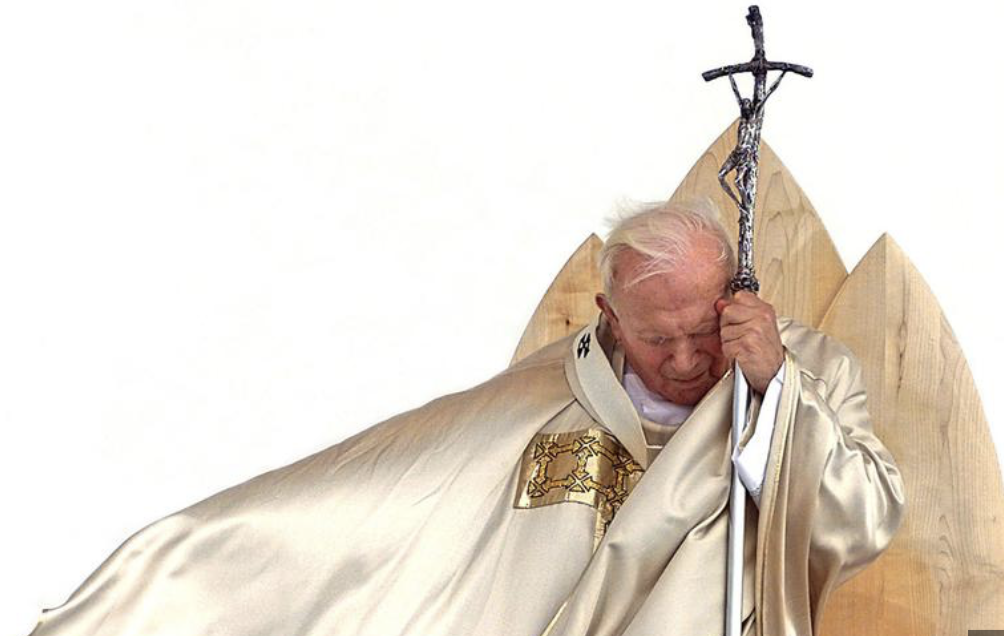
I have become curious about how Saint Pope John Paul II would have understood parts. He was deeply invested in phenomenological inquiry to understand the lived experience of persons, and he certainly would have understood internal conflicts and inner woundedness. Although John Paul II was likely unfamiliar with Internal Family Systems, I have come to believe he would have appreciated the truth about inner multiplicity.
At the very beginning of John Paul II’s (then Karol Wojtyla) Love and Responsibility, he speaks of interiority and how humans, compared to other animals, have an interior spiritual life. This interiority makes someone a person and persons are nontransferable and incommunicable.
In the Theology of the Body addresses, John Paul II discusses the heart, and he speaks of a “threefold concupiscence of the human heart” where one aspect (perhaps one can see these as burdens carried by parts…) has “pride of life” emphasized by Nietzsche, another “concupiscence of the eyes” represented by Marx, and another has “concupiscence of the flesh” analogous to Freud’s concept of the id. John Paul II says we must appeal to the human heart, not to focus on the desires of the world, but to welcome the Father’s love. We are to invite Christ’s redemptive love to these aspects of our burdened and misguided hearts to address concupiscence (inclination to sin or inclination toward disordered attachments).
Parts work and true freedom
John Paul II states, “Man must feel himself called [by Christ] to rediscover, or even better, to realize the spousal meaning of the body and to express in this way the interior freedom of the gift, that is, the freedom of that spiritual state and power that derive from mastery of the concupiscence of the flesh.” (TOB 46:4)
Parts work, when practiced appropriately, offers a unique way to approach our interior world to address these burdens and these unhealthy attachments to promote greater levels of true freedom.
In his addresses, John Paul II describes how Christ communicates with the inmost self to bring about this redemptive work: “The words of Christ, who in the Sermon on the Mount appeals to the “heart,” lead the listener in some way to such an inner call. If he allows them to work in him he can at the same time hear in his innermost [being] the echo, as it were, of that “beginning,” of that good “beginning” to which Christ appealed on another occasion to remind his listeners who man is, who woman is, and who they are reciprocally; one for the other in the work of creation.” (TOB 46:5).
Loving ourselves properly
John Paul II continually uses the spousal analogy that points to this profound union between each person and God. The heart is being called to its supreme value which is love. Our deepest inheritance is not a sinful heart but one that is capable of great love. Our hearts are to be transformed. We are to love ourselves and others in a way that respects our dignity as human persons.
In parts work, when we love ourselves properly, we care for our parts with tenderness. We seek to understand our inner struggles, and we seek to free our parts of the false beliefs and negative coping strategies that burden them. We seek to transform the inner world into one that does not treat itself or others as objects. In my view, Theology of the Body provides the philosophical and theological framework for understanding the dignity of the human person. Parts work provides a practical path in the natural realm to heal and help restore that dignity. And it is this healing on the natural level, this human formation, that paves the way for greater spiritual growth and deeper experiences of God’s love.
Intersection of Theology of the Body and parts work
I have attended the Theology of the Body Institute’s introductory course as well as the course on Karol Wojtyla’s (Saint Pope John Paul II) book Love & Responsibility. These powerful and insightful courses have really prompted me to reflect on the intersection between Theology of the Body (TOB) and Parts Work. Christopher West, in the upcoming episode 177 of the Interior Integration for Catholics podcast, tells Dr. Peter and I that he sees TOB and IFS as complementary. Be sure to watch the video or listen to the audio when it comes out on December 1, 2025.
Christopher West uses a picture drawn by his daughter Beth in his TOB courses. It shows three figures: a repressed man, an indulgent man, and a man filled with the grace of God. He brilliantly describes these as three options especially in relation to our sexuality. We can repress our sexuality, we can indulge our sexuality, or we can redirect it to God in a mystical way. Mysticism is an experience where we connect with God on such an intimate level that every part of us, including our sexuality, is directed to God. We experience the reality of our “mystical marriage” (see Catherine of Siena) with Christ the Bridegroom and we unite ourselves with God in a way that really defies any human words or metaphors.
IFS, or parts work in general, has an approach to our parts that is gentle, kind, and understanding. We may recognize that we have a manager part (or multiple parts) who might try to repress our sexuality. We may have a firefighter part (or multiple parts) that wants to indulge our base desires. Christopher West would say both are “half right.” We need managers who will help us attain self-mastery and self-possession. But we also need to recognize that our sexual instincts are essentially good, sacred in fact, and need ordered and healthy expression.
How do we avoid either extreme?
The answer lies in our inmost self, our inner mystic, our spiritual center, who can direct our sexual energy to union with God. We must first identify our blended parts, perhaps a manager part who represses, or a firefighter part who indulges, and connect with them. Instead of exiling these parts, we invite them closer. We take the time to understand how these parts developed and how these parts learned that either repression or indulgence was the only option available to survive.
We can choose to appreciate the way our parts have learned to survive. We appreciate their efforts, usually tireless ones, to cope.
We invite them to discover that there are new options now. We have new resources that we did not have in the past. We can meet our needs in ways that are healthy and that will align with our values.
What is chastity?
The Catechism of the Catholic Church, initiated and promulgated by John Paul II, states the following: “Indeed it is through chastity that we are gathered together and led back to the unity from which we were fragmented into multiplicity.” (CCC 2340). When the Catechism (or Saint Augustine) talks about inner fragmentation and a return to unity, I don’t believe they mean to imply that chastity or redemption causes us to become an inner monolith with no parts.
When our parts are fragmented, they conflict with each other and with the inmost self, and our inner world is in chaos rather than harmony. Integration does not mean that our parts are melded into one uniform one dimensional mind. Integration means that our inner multiplicity is harmonious, and the inner diversity and resources offered by our inner parts are working in full swing with a united purpose. Chastity is the virtue that makes this beauty possible.
Chastity, then, is the virtue of human integration. As we integrate our parts and bring them into harmony with each other, and with the inmost self, and ultimately with Christ, we experience a sense of wholeness. We accept that we need to master our base desires not by repressing them but by channeling them properly.
Self-mastery involves setting boundaries and keeping them. We need to say “no” to options that reinforce our fallen nature. We need to stay true to our values because we believe fervently that they are good. But at the same time, we need to acknowledge the beauty and the intrinsic goodness of our sexual desires. Our desire for emotional and sexual intimacy reflect a deeper desire to be united with God. Our bodies are good, and our sexuality is a gift from God.
These may seem like irreconcilable differences (our desires and our values), but they are not. We acknowledge beauty. We acknowledge desire. We accept what comes naturally to our minds, to our affections. But we also stay true to our commitments and to our values. We choose to see people, not as objects that are only meant to meet our base desires, but as persons who are worthy of love and respect.
Appreciating beauty
We learn to appreciate beauty, but we also learn that it is not always (or typically) ours to possess.
We learn that love is about wanting what is truly good for ourselves and others. Theology of the Body teaches this truth. Parts work helps us enact it in our inner world.
We live in a world replete with beauty that we can never possess. We can only appreciate. We can only savor. We cultivate a life of gratitude as we smell a flower, as we climb a tree, as we meet a new friend, as we stare into the night sky, and as we notice the beauty in another man or woman.
Even in marriage with its physical intimacy, beauty is ours to marvel in but not ours to possessively and selfishly own. It is a gift we receive and a gift we give. And it all points to a greatness that is beyond us, a greatness that is divine, the living God who is both present and above. This beauty exists beyond us and within us. Our intimacies, whether physical in marriage, or emotional in friendship, etc. reflects this great beauty and celebrates it.
Chastity is accepting these truths that are my inheritance as an adopted child of God through Jesus Christ: we are His children despite our fallen nature. We are meant for greatness despite our failings. We are chosen. We belong. We are His. We are beloved. He rejoices in me. He heals me. He feeds me. He is always with me. He is kind. He knows me. He forgives me. He redeems me. He lavishes His grace on me. I am His child.
Chastity means every part of me accepts this inheritance and rejoices. Chastity means every part of me is grateful and humbled as I experience His love. And chastity leads me to want to share this love with others.
Let us rejoice in our interior world as we celebrate this great love of the Trinity reflected in our very bodies.
Saint Pope John Paull II, pray for us!
May God bless you on your journey this week.
Resources:
Sign up for a Theology of the Body Institute course
Wojtyla, Karol (2013). Love and Responsibility. Grzegorz Ignatik (tr.) Boston: Pauline Books & Media
John Paul II (2006). Man and woman He created them: A theology of the body. Michael Waldstein (tr.) Boston: Pauline Books & Media.
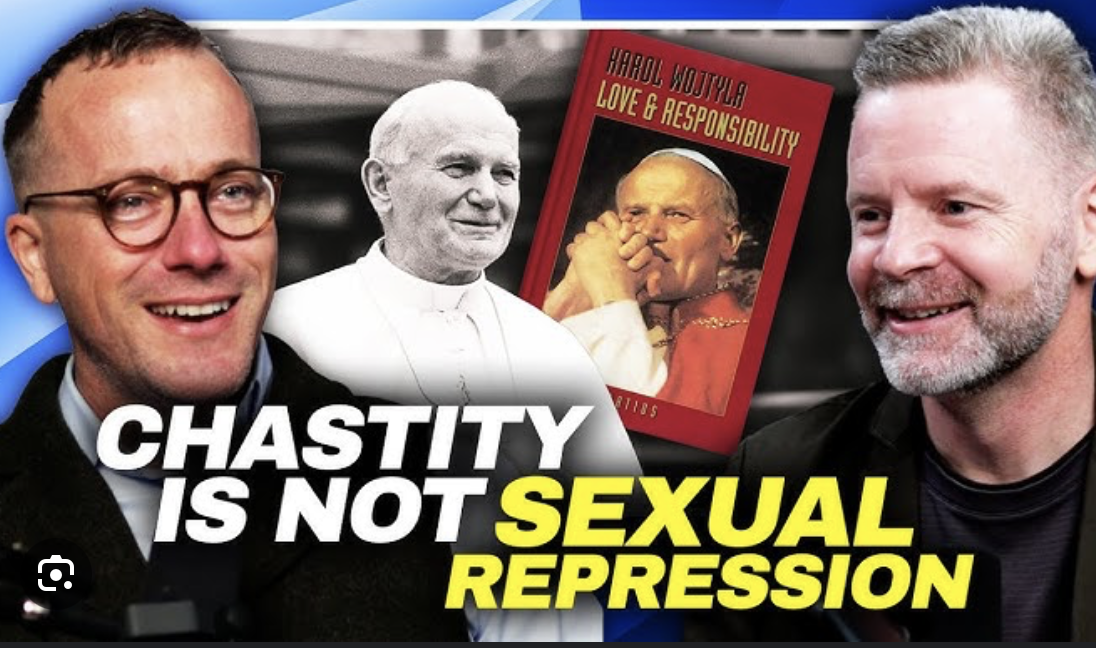
Enjoy part one of this six-part series where Christopher West and Matt Fradd study Love and Responsibility.
Christ is Among us!
Dr. Gerry Crete
Dr. Gerry Crete, Ph.D., LPC, LMFT
Dr. Gerry Crete is the founder and practice director of Transfiguration Counseling and Coaching and author of Litanies of the Heart: Relieving Post-traumatic Stress and Calming Anxiety Through Healing Our Parts, published by Sophia Institute Press. A therapist with expertise in trauma and anxiety disorders, Dr. Crete is trained in Internal Family Systems (IFS), Ego State Therapy, and Clinical Hypnosis. He is also an EMDR certified therapist and consultant. Dr. Crete works with individuals, couples, and families, including seminarians, priests, and religious, and teaches at Saint Vincent’s Seminary in Latrobe, PA.
Stay informed about the latest research in psychology.
%20%5BRecovered%5D-09.webp)
%20%5BRecovered%5D-10.webp)