
November 3, 2025
The Chosen is a television series about the life and ministry of Jesus of Nazareth and his disciples. Many of the seasons also appeared in theatres (grossing over $120 million as of May 2025), and it currently streams on Amazon Prime. It has been seen by an estimated 280 million viewers. It was created, directed, and co-written by evangelical Christian Dallas Jenkins (whose father, a dispensational premillennialist, wrote the popular Left Behind series of books) who raised the money for most of the series through crowdfunding. There are five seasons as of this writing with eight episodes per season. Jenkins is planning to produce two more seasons.
I resisted watching The Chosen for five years. Many faithful Catholics told me I just had to watch it and that it was so well done! The main reason for putting it off is that I don’t trust anyone to do the story and portray the characters of Jesus and His apostles well. As it is, I’m fussy about religious art in general and I’m sensitive to non-nuanced and overly biased portrayals of religious figures in film. Jesus, the apostles, and all the Gospel stories have a unique and special place in my heart, in my mind’s eye, and I don’t want other people’s distorted versions in my head.
Portrayals of Jesus
Among the many actors who have played Jesus, I’ll go through a few that stand out in my memory. We’ve had “teenage heartthrob” Jesus in 1961’s unnuanced King of Kings with Jeffrey Hunter (aka the original Captain Pike from Star Trek) who was in the end perhaps too serious.
Ted Neeley’s “hippie” Jesus from the musical Jesus Christ Superstar is certainly memorable as he captures a very human Jesus with a great deal of emotional depth.
I remember thinking that Robert Powell’s “otherworldly” Jesus in the 1977 miniseries Jesus of Nazareth was impactful if not somewhat formal. Powell attempted to capture a balance between Jesus’ humanity and divinity – not an easy task, and many feel he emphasized the divine.
Jim Caviezel’s portrayal of Jesus, perhaps my own favorite up to the present, moved me and continues to move me. There is so much incredible emotional depth in 2004’s The Passion of the Christ, a film that was both artistically beautiful and theologically profound. Having said that, the film is more about his suffering than about him as a person. That might be overstating it, and this is not a criticism, but all the various facets of his person and his ministry are not the focus.
[PS: “Look mother, I make all things new” is still a line that makes me tear up every time.]
Authentically human
At some point a few months ago, and for no particular reason, I felt compelled to ask my wife if she wanted to watch The Chosen with me. After all, I am now a film critic who writes for a predominantly Christian audience. She said yes, and we binge watched the show for the next few months. Although far from perfect, I enjoyed most of the run and eagerly looked forward to each new episode.
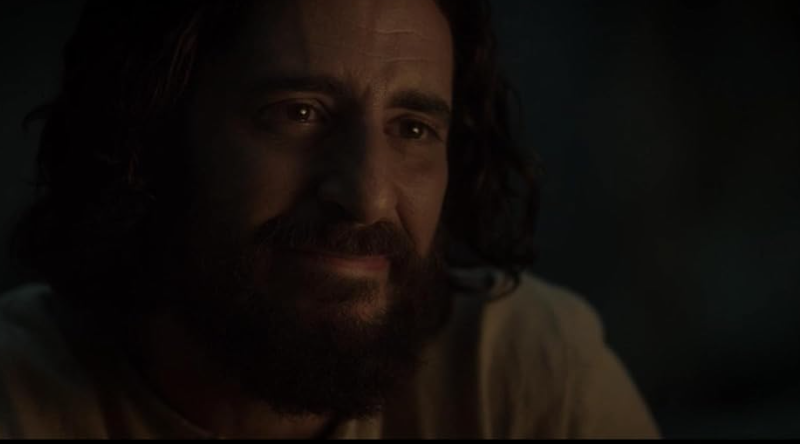
So, what does Jonathan Roumie from The Chosen bring to the role? He’s a very human Jesus. Ok, he’s not just human, he’s authentically human. I’d like to argue that his humanity also reveals his divinity in a way that no other performance has done before.
Readers of my book Litanies of the Heart may recall that in Chapter 3, The Inmost Self, I do a mini-phenomenological study of the person of Jesus in the Gospels. My premise was that the Jesus of the Gospels would be the best template for the inmost self. The reason for this is that the inmost self is the best reflection of the image of God in the human soul.
The person of Jesus demonstrates what it is to be a perfect human, a divinized human – the type of human we can aspire to be if we surrender in faith, receive grace, and take the path of sanctification – but a very human human. I will take a moment to analyze how Jonathan Roumie’s Jesus embodies (or in a few places doesn’t) these characteristics of the inmost self.
Jesus characterizes the inmost self
In The Chosen, Jesus is seen as a “lover.” He presents himself to each apostle and follower with gentleness and humility. He is a “seeker” who seeks out each character and relates to each one individually. He is a “protector,” despite warning them of trials to come, he empathizes with them and helps to take care of their material needs.
Jesus is portrayed as a “true friend” who truly cares about and enjoys the company of his disciples. He is a “healer” in many ways and not just physically. He is the “pathfinder” who brings the disciples to greater levels of holiness, and he is the “bridge builder” who unites these disparate characters. As a “nurturer” he not only feeds them fishes and loaves, but he cares for, teaches, and prepares his disciples over time.
Interestingly, this Jesus is also sometimes frustratingly enigmatic and sometimes inscrutable to his disciples. He isn’t just “nice,’ he is knowing. He doesn’t shield them from every obstacle and prevent their suffering. He tries to prepare them and offer warnings without burdening them with the future trials yet to come. He observes their naïve excitement and does little to temper their enthusiasm (other than rebuking James and John). At times he gets impatient and frustrated, especially in season 5 as he prepares for his passion.
Overall, the Jonathan Roumie Jesus feels very “present” to his disciples. He is relaxed in his own skin, humorous, and likable. He displays genuine compassion for the struggles and difficulties of his followers. To the confusion of many of his disciples, however he doesn’t typically solve all their problems by using his divine powers. For example, he doesn’t heal “Little” James’ disability, prevent Peter’s wife’s miscarriage, or raise Thomas’ fiancée from the dead. He doesn’t seem driven by a human agenda when it comes to his disciples. His only agenda is to guide them to where they are being called to by God. He does sit with his disciples individually and listen to them. He is kind and never coercive.

His apostles represents parts
I want to point out something that I also pointed out in Litanies. If in some way Jesus of the Gospels represents the inmost self, then the apostles can also be understood to represent our parts.
We relate to the characters and stories because we all have within us an inner tax collector, an inner prostitute, an inner pharisee, an inner good Samaritan, and an inner prodigal son. These are stories that speak to our soul and each one of our parts. This series is about the many dimensions of Jesus and the diversity within his follower group. In a certain sense, it is about Jesus the inmost self, and it is about the disciples, the parts of the self-system.
Jesus, the bridge builder, helps bring together polarized parts. The best example of this is the relationship between Peter (played by Israeli actor Shahar Isaac) and Matthew (played by Paras Patel). This Peter, with his swagger and L’Oreal hairstyle, is self-confident and despite his bad boy tendencies, he is principled and patriotic.
Matthew meanwhile sold out his people and became rich as a tax collector. Matthew is also socially awkward and obviously on the spectrum. Peter doesn’t like him and even bullies him. Jesus calls Peter to be the leader of the disciples and gently guides him toward forgiving and reconciling with Matthew, one of the more powerful moments in the series in my opinion. Jesus, the inmost self, facilitates but does not manhandle the relational repair between two parts of the early church self-system.
Jesus, the lover and pathfinder, helps Mary Magdalene (played by Elizabeth Tabish) turn from a life of sin and shame. Not only that, but he continues to love her even after she has a relapse. He is tender with her, he understands her trauma, and he knows that she is on a journey. She goes from being a “firefighter” type character to an important member of the company. She becomes a symbol of redemption who helps others with care and empathy.
The portrayal of Mary and Martha as two polarized parts is thoughtfully done. We see Mary adoring Jesus and wanting to absorb all his teachings while Martha (resentfully) does all the cooking and hosting. Jesus praises Mary for her faith and devotion, emphasizing the importance of “being” over “doing.” Perhaps humorously, however, Jesus does take a slight dig at Mary (“she could help out a bit”), and he gets the men to clean up. As an aside, the actual taboo-breaking behavior of Jesus occurs in the Gospels when Jesus washes his disciples’ feet, not in Jesus getting the disciples to do the dishes…
Jesus, the seeker, makes interesting inroads with members of the priestly class. The first is with the Pharisee Nicodemus who is artfully portrayed by Erick Avari. He is a good, respected, and intelligent man, a member of the Sanhedrin, and he is moved by Jesus. He is sincere but conflicted as supporting Jesus would disrupt his life, family and career.
There is a powerful scene based on John 3 where Nicodemus meets with Jesus at night. Nicodemus’ faith journey here is one of the more profoundly moving moments in the series. The other member of the Sanhedrin to be personally moved by Jesus is Yussif (played by Ivan Jasso), or Joseph of Arimathea, the son of a wealthy family. He defends Jesus to the council even though it makes him unpopular.
Concerns and questions
As I intimated, I was pleasantly surprised by this series, but it wasn’t perfect. I don’t want to write a belabored critique, but let me outline a few concerns and questions that I had:
Acceptable liberties
What I wasn’t bothered by (but thought I might be):
At the end of the day, I was encouraged by this program, its high production values, its talented actors, and, in general, its creative storytelling, all the while staying true to the basic Gospel narrative. Jonathan Roumie’s “human” Jesus is kind and present, gentle and strong, humble, empathetic, and loving (yet not against ruffling a few feathers or knocking over a few tables).
The followers of Jesus, the Chosen, represent a real diversity of personalities and personal struggles, they were as relatable as our own parts. As long as we understand that there have been creative liberties, we can see the truth in the message and the power of media to inspire.
Dr. Gerry Crete
Dr. Gerry Crete, Ph.D., LPC, LMFT
Dr. Gerry Crete is the founder and practice director of Transfiguration Counseling and Coaching and author of Litanies of the Heart: Relieving Post-traumatic Stress and Calming Anxiety Through Healing Our Parts, published by Sophia Institute Press. A therapist with expertise in trauma and anxiety disorders, Dr. Crete is trained in Internal Family Systems (IFS), Ego State Therapy, and Clinical Hypnosis. He is also an EMDR certified therapist and consultant. Dr. Crete works with individuals, couples, and families, including seminarians, priests, and religious, and teaches at Saint Vincent’s Seminary in Latrobe, PA.
Stay informed about the latest research in psychology.
%20%5BRecovered%5D-09.webp)
%20%5BRecovered%5D-10.webp)

.png)